A good rug can make a room warmer. A great Chinese antique rug can make a room feel as if it has read several history books and still has excellent manners.
In traditional China, carpets appeared in palaces, temples, homes, ceremonies, and religious spaces. Over time, they became cultural artworks shaped by geography, wool, dyeing, belief, and design rules. Their beauty lies in balanced composition, symbolic motifs, elegant color, and skilled hand weaving.
At Dongsheng Carpet, we study these historical design systems as living knowledge. When a designer understands why a dragon coils around a pillar rug, why a Ningxia rug loves symmetry, or why Xinjiang carpets glow with red geometry, a custom rug becomes more than decoration.
1. Why Chinese Antique Rugs Still Matter
The presentation of Chinese ancient rug design highlights one essential idea: old carpets moved beyond ordinary utility. Many early examples no longer survive, and most known antique pieces are preserved in palaces, temples, museums, or private collections.
That scarcity is why their design language matters. We can study their visual grammar and bring the spirit into modern handmade Chinese rugs.
| Design Element | What It Means | Why Buyers Notice It |
| Pattern | Flowers, dragons, Buddhist treasures, geometric borders | Gives the rug story and identity |
| Color | Indigo blue, turmeric yellow, rust red | Creates natural depth and warmth |
| Composition | Symmetry, medallions, framed borders | Makes the design feel calm and premium |
| Craft | Hand knotting, wool selection, finishing | Determines touch, durability, and value |
2. Ningxia Rugs: Order, Elegance, and a Very Disciplined Sense of Beauty


Ningxia rugs are among the most representative categories in Chinese carpet design. The Ningxia region was closely connected with the Alashan Plateau and became an important center for wool collection, carpet trade, and temple rug production.
The most charming feature of Ningxia rug design is its sense of order: center, border, corner, and surrounding structure working together like a polite orchestra. Nobody shouts. Everyone knows their seat.
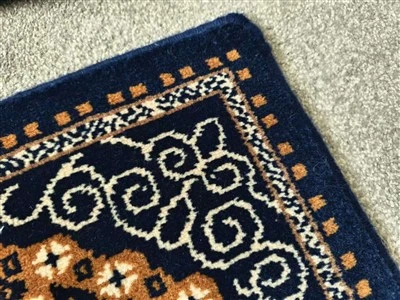
Common Ningxia rug motifs include brocade-ground patterns, floral roundels, longevity symbols, peonies, Buddhist symbols, dragon designs, and auspicious borders. Colors often include yellow, indigo blue, rust red, camel, and white. Warm and cool contrast gives the pattern life without turning the rug into a color festival that forgot restraint.
3. Temple and Palace Rugs: Where Function Wears Formal Clothes
Chinese antique rugs were often designed for specific settings. Temple carpets included prayer rugs, hanging carpets, pillar carpets, door curtain rugs, and meditation rugs. Palace rugs and gift rugs appeared in formal halls, celebrations, birthdays, and important social occasions.
This matters for modern custom rug design. A rug for a hotel lobby, luxury residence, tea room, gallery, or cultural project should not be treated as "just a rectangle with decoration." Traditional Chinese carpet design teaches us to ask:
- Will the rug be viewed from above, from a doorway, or while seated?
- Does the space need ceremony, warmth, calm, or energy?
Dongsheng Carpet brings these questions into design development. Pattern is planned with space, scale, use, and cultural tone in mind.
4. Baotou Carpets: Floral Beauty with a Scholar's Smile
Baotou carpets are known for vases, flowers, birds, deer, cranes, auspicious objects, and refined borders. Compared with bold Xinjiang carpets, Baotou designs can feel more literati, more indoor, more "I own a tea set and I know where every cup belongs."
They are excellent references for interiors that need cultural character without becoming visually heavy, such as studies, boutique hotel suites, and reception rooms.
5. Tibetan Rugs: Bold Spirit, Thick Texture, and Symbolic Power
Tibetan rugs developed from the environment, religion, and daily life of the plateau. They used local wool and strong symbols: tigers, dragons, snow lions, Buddhist treasures, lotus patterns, and mountain-water forms. If a minimalist beige rug whispers, a tiger Tibetan rug clears its throat.
Traditional Tibetan rugs are associated with hand spinning, plant dyeing, hand weaving, and particular knotting methods. For modern custom rugs, this inspiration is powerful when clients want warmth, story, and visual confidence.


6. Natural Dyes: Color with a Memory
Traditional Chinese carpets often used plant and mineral dyes. Ningxia rugs are associated with turmeric yellow, indigo blue, and rust red. Xinjiang carpets used materials such as pomegranate peel, walnut peel, safflower, and madder. These colors do not look flat. They breathe.
Slightly varied wool tones can look warmer than a perfectly uniform surface. Nature is not lazy; it simply has better taste than most color charts.
7. Xinjiang Carpets: Geometry, Warmth, and Silk Road Confidence
Xinjiang carpets reflect a fascinating design crossroads, influenced by local ethnic traditions, Central Asian aesthetics, Islamic decorative rhythm, and Silk Road exchange. Common motifs include pomegranates, medallions, vines, geometric repeats, and framed fields.
Red is especially important. It creates warmth, celebration, and strong interior presence. A Xinjiang-inspired custom carpet makes the space feel lively before anyone says a word.


8. How Dongsheng Carpet Turns Heritage into Modern Custom Rugs
The professional value of Dongsheng Carpet is not only in making rugs, but in understanding why a rug looks right. Several practical principles emerge:
| Traditional Principle | Modern Application |
| Use a clear center and border | Creates visual order for hotel lobbies, villas, and formal spaces |
| Match motif to meaning | Flowers, dragons, waves, and treasures can support brand or interior themes |
| Control color contrast | Balances impact with elegance for luxury interiors |
| Respect material and handcraft | Improves texture, durability, and high-end customer experience |
For clients, Dongsheng Carpet supports more than production. We help interpret traditional Chinese carpet design into modern solutions: custom sizes, color development, motif adaptation, hand-tufted or hand-knotted options, and rug concepts for commercial or residential projects.
9. The Secret: Ancient Rugs Are Design Systems
The biggest lesson from Chinese antique rugs is simple: beauty is organized. The border is not decoration for empty edges. The center is not just a convenient place to put a flower. The color is not chosen because someone found a red thread and felt optimistic.
Every decision has a job. Borders protect and frame. Centers gather attention. Repeated motifs create rhythm. Colors carry ceremony, identity, and mood. Craft turns a drawing into something durable.
Chinese antique rugs offer history without stiffness, symbolism without noise, and craftsmanship without shortcuts. For brands, designers, and homeowners looking for handmade Chinese rugs or custom rugs with cultural depth, this heritage is extremely useful.


Dongsheng Carpet combines historical design study, pattern development, color planning, and professional carpet craftsmanship to create custom rugs inspired by Chinese antique rug traditions. Whether the direction is Ningxia elegance, Tibetan boldness, Xinjiang warmth, Baotou refinement, or palace rug luxury, the goal is the same: a rug that looks beautiful, feels excellent, and knows why it is there.