

Are you ordering more carpet than your project actually needs?
Imagine you're renovating a hotel. Your contractor tells you that the project needs 1,000 m² of carpet. But when you receive the supplier's quotation, the quantity has increased to 1,200 m².
Where did the extra 200 m² come from?
The supplier might explain that it's for cutting waste, pattern matching, or installation. These are legitimate considerations. But how do you know whether the additional quantity is reasonable?
The good news is that you don't need to be a carpet expert to check the basic calculations.
In this guide, we'll show you how to estimate carpet quantities, compare different roll widths, understand cutting waste, and ask the right questions before placing an order.
1. First, Understand What You're Paying For
Let's start with three simple terms.
Net Floor Area: The actual floor area you want to cover with carpet.
Carpet Order Quantity: The total amount of carpet you need to purchase, including necessary cutting and installation allowances.
Carpet Waste: The material left over after cutting and installation that cannot be used elsewhere in the project.
Here's a simple example.
Your room measures 7m × 8m.
Net floor area: 7 × 8 = 56 m²
You might expect to buy exactly 56 m² of carpet. However, carpet comes in rolls of fixed widths, and you may need to cut and join several pieces to cover the floor.
This can result in extra material.
The important question is not whether waste exists, but whether the proposed cutting layout uses the material efficiently.
A supplier should be able to explain how the order quantity was calculated.
2. A Simple Trick That Can Save You Money: Compare Carpet Widths
One of the easiest ways to reduce carpet waste is to choose a roll width that suits your room dimensions.
For example, let's compare two carpet widths:
4.00 meters
3.66 meters
Remember, a wider carpet is not always the more economical choice.
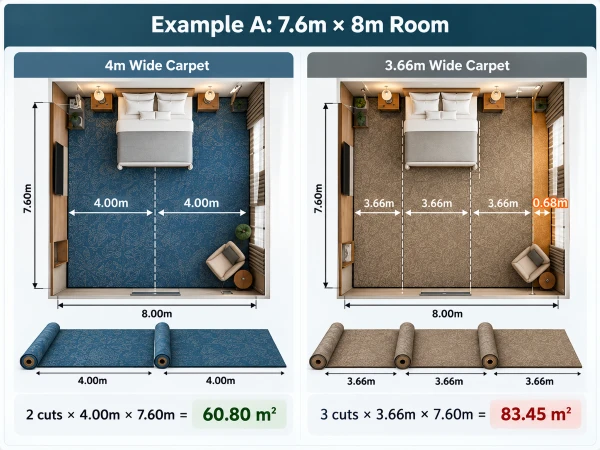
Example A: A Room Measuring 7.6m × 8m
The net floor area is: 7.6 × 8 = 60.80 m²
Option 1: Using 4m-Wide Carpet
Instead of cutting two 8m-long pieces, we turn the layout 90 degrees.
Now the two carpet widths fit exactly along the 8m side of the room.
Each piece measures: 4m × 7.6m
Total carpet quantity: 2 × 4 × 7.6 = 60.80 m²
Theoretical cutting waste: 0 m²
That's an exact fit before practical cutting allowances.
Option 2: Using 3.66m-Wide Carpet
With the same orientation, two carpet widths cover: 3.66 × 2 = 7.32m
But the room is 8m across, leaving a strip 0.68m wide.
We need three cuts, each 7.6m long, if we use full-width cuts and do not reuse the unused portion.
Total carpet quantity: 3 × 3.66 × 7.6 = 83.45 m²
Theoretical unused material: 83.45 − 60.80 = 22.65 m²
That's approximately 37.2% more material than the actual floor area.
The Result
| Comparison | 4m Carpet | 3.66m Carpet |
|---|---|---|
| Net floor area | 60.80 m² | 60.80 m² |
| Full-width cuts | 2 | 3 |
| Material quantity | 60.80 m² | 83.45 m² |
| Theoretical unused material | 0 m² | 22.65 m² |
In this particular layout, 4m-wide carpet is significantly more material-efficient.
However, the large leftover piece from the 3.66m option might be useful in another room or corridor. If it can be reused, the overall project waste could be lower.
That is why a complete project layout is better than calculating every room separately.
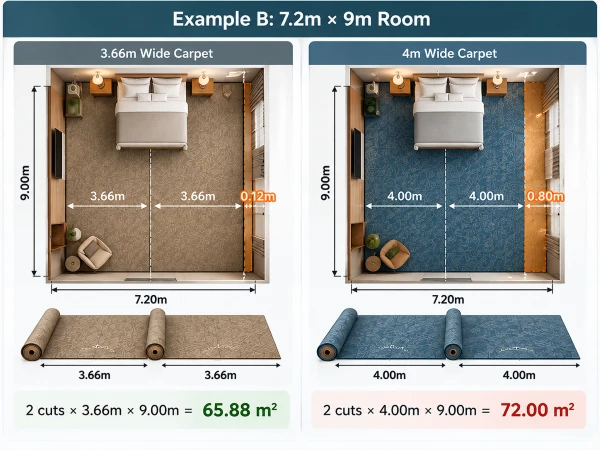
Example B: A Room Measuring 7.2m × 9m
Now let's look at a room where 3.66m-wide carpet is the more economical choice.
The net floor area is: 7.2 × 9 = 64.80 m²
Option 1: Using 3.66m-Wide Carpet
Two pieces of 3.66m-wide carpet can cover the 7.2m side, with only 0.12m left over.
Total carpet quantity:2 × 3.66 × 9 = 65.88 m²
Theoretical unused material:65.88 − 64.80 = 1.08 m²
Option 2: Using 4m-Wide Carpet
Two pieces of 4m-wide carpet can also cover the 7.2m side, but this leaves a wider unused strip.
Total carpet quantity:2 × 4 × 9 = 72.00 m²
Theoretical unused material:72.00 − 64.80 = 7.20 m²
Which Option Saves More?
The Result
| Comparison | 3.66m Carpet | 4m Carpet |
|---|---|---|
| Net floor area | 64.80 m² | 64.80 m² |
| Carpet quantity | 65.88 m² | 72.00 m² |
| Theoretical waste | 1.08 m² | 7.20 m² |
| Waste percentage | 1.67% | 11.11% |
In this example, choosing 3.66m-wide carpet saves 6.12 m² of material, compared with the 4m-wide option.
What Can We Learn?
A wider carpet doesn't always mean less waste.
As Examples A and B demonstrate, even a small difference in room dimensions can change which carpet width is more economical.
Before accepting your supplier's quotation, ask whether different roll widths and laying directions have been compared.
The smartest way to save money isn't simply to choose the cheapest carpet-it's to choose the most cost-effective cutting layout.
3. How to Check Your Supplier's Carpet Quantity Calculation
You don't need expensive software to make an initial check.
Start with these five steps.
Step 1: Measure Your Floor
For a rectangular room:
Floor Area = Length × Width
For irregular rooms, divide the space into smaller sections and calculate them separately.
For hotels, calculate guestrooms, corridors, and public areas separately, particularly if they use different carpet designs.
Step 2: Ask About the Available Roll Width
Carpet is manufactured in specific widths.
Ask your supplier:
"What roll widths are available for this carpet?"
Not every carpet can be produced in every width. Available options depend on the manufacturing process and equipment.
Step 3: Try Both Installation Directions
This is one of the most important checks.
For a rectangular room, compare the quantity required when the roll length runs:
Parallel to the room's length
Parallel to the room's width
Calculate both possibilities and see which requires less material.
However, don't rotate a patterned or directional carpet without confirming that the design, pile direction, and installation requirements allow it.
Step 4: Check the Leftover Pieces
Suppose your project has 100 identical guestrooms.
A cutting layout may leave a narrow strip from every room.
Before accepting these strips as waste, ask whether they could be reused in closets, smaller rooms, or other suitable areas.
This depends on the dimensions, carpet design, pile direction, and seam requirements.
A good cutting plan considers the whole project, not just one room.
Step 5: Request a Carpet Layout Drawing
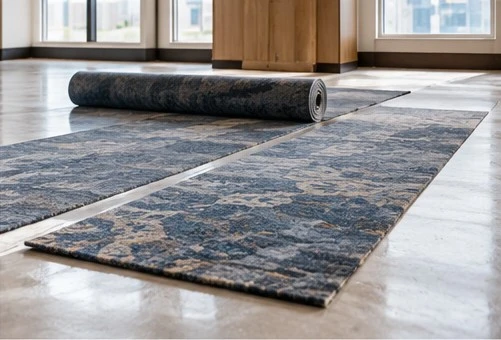
For a large hotel project, ask the supplier or installation contractor for a cutting layout based on your CAD floor plans.
Ideally, the drawing should show:
Carpet roll width
Cutting lengths
Installation direction
Seam locations
Pattern repeat, where applicable
Areas of unused material
Estimated total order quantity
You can then compare the layout against the quotation.
4. Don't Accept a Waste Percentage Without an Explanation
You may receive quotations that simply add 5%, 10%, or 15% to the net floor area.
But is that reasonable?
It depends.
A rectangular ballroom may allow a relatively efficient layout, while a hotel with many small or irregular rooms may require more cutting and joining.
Patterned carpets may also need extra material to match the designs at seams.
There is no single waste percentage that works for every project.
For example, imagine two suppliers quote for a project with a net floor area of 1,000 m².
| Supplier A | Supplier B | |
|---|---|---|
| Net floor area | 1,000 m² | 1,000 m² |
| Quoted quantity | 1,200 m² | 1,100 m² |
| Additional quantity | 20% | 10% |
Supplier B appears to have a more efficient estimate.
But before making a decision, request the cutting layouts from both suppliers.
A lower quoted quantity is only an advantage if it is sufficient for the approved installation.
Don't automatically accept the highest estimate, and don't automatically choose the lowest one either. Ask to see how the numbers were calculated.
5. Patterned Carpet: Why the Cheapest Layout May Not Work
If you're purchasing patterned Axminster, printed, or tufted carpet, quantity calculations become more complicated.
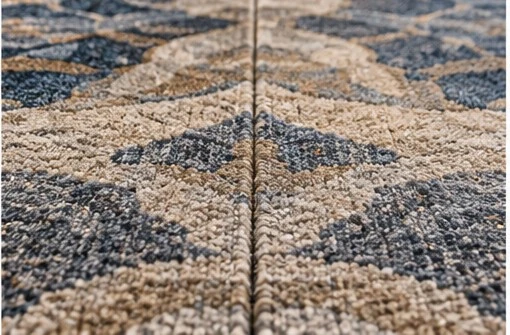
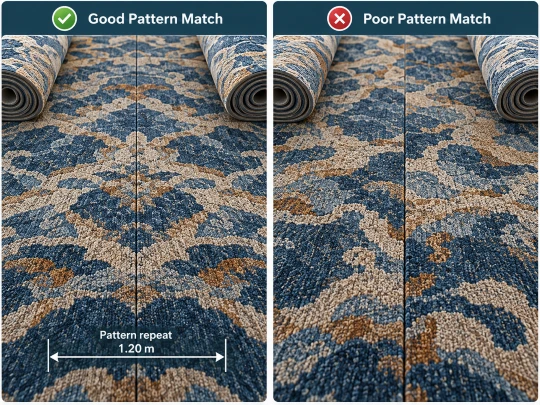
Imagine two carpet pieces installed side by side.
If their patterns don't align, the seam may become obvious and spoil the appearance of the floor.
That's why patterned carpets sometimes require additional material for pattern matching.
The Carpet and Rug Institute's CRI 104 commercial carpet installation standard addresses pattern direction, seam planning, and matching allowances.
Before finalizing the quantity, ask:
- What is the pattern repeat?
- Does the design have a fixed direction?
- Where will the seams be positioned?
- How much extra material is needed for matching?
- Can the layout be improved without affecting the final appearance?
The goal is not simply to achieve zero waste.
It's to minimize unnecessary waste while maintaining the required installation quality.
6. The Lowest Carpet Quantity Doesn't Always Mean the Lowest Cost
Here's another point buyers sometimes overlook.
Imagine two suppliers offering carpet for the same room.
| Supplier A | Supplier B | |
|---|---|---|
| Carpet width | 4m | 3.66m |
| Carpet quantity | 60.80 m² | 83.45 m² |
| Unit price | $14/m² | $11/m² |
| Material cost | $851.20 | $917.95 |
Illustrative prices only. Both options are assumed to meet the same project specifications.
Supplier B offers a lower price per square meter.
But because the required material quantity is higher, the total carpet material cost is greater.
Supplier A is approximately $66.75 cheaper in this example, before additional costs.
This is why you should compare: Total Carpet Material Cost = Order Quantity × Unit Price
- Installation labor
- Seam preparation and finishing
- Shipping and handling
- Import-related costs
- Project-specific accessories
- Any maintenance stock required
- A cheaper carpet is not necessarily a cheaper flooring solution.
7. Six Questions to Ask Before Approving Your Carpet Order
Before you accept the quotation, use this checklist:
1. How did you calculate the total carpet quantity?
Ask for the estimated net area and gross order quantity.
2. Have you compared different roll widths?
Find out whether an alternative width could reduce material consumption.
3. Have you checked both possible laying directions?
Confirm that the proposed direction is suitable for the design.
4. Can leftover material be reused elsewhere?
For larger projects, ask about optimization across multiple rooms.
5. Does the estimate include pattern-matching allowances?
If yes, ask how those allowances were determined.
6. Can you provide a cutting layout drawing?
A detailed layout makes the quotation easier to verify and helps prevent misunderstandings before production.
8. How to Reduce Carpet Costs Without Compromising Quality
Reducing carpet costs doesn't have to mean choosing a cheaper material.
Sometimes, better planning is enough.
Here are a few practical ways to improve purchasing efficiency.
Plan before ordering. Send accurate dimensions or CAD drawings instead of relying only on an estimated floor area.
Compare suitable widths. A difference of just a few centimeters can change the number of required cuts.
Review the entire project. Repeated hotel room layouts may create opportunities to reuse suitable offcuts.
Confirm patterns early. Late design changes can affect cutting plans and material requirements.
Coordinate with the installer. Seam placement and installation direction should be checked before approving the final quantity.
Compare total costs. Look beyond the price per square meter and evaluate the complete material and installation requirements.
9. What Should You Send to a Carpet Manufacturer?
If you are preparing a hotel renovation or commercial carpet project, the following information will help your supplier prepare a more accurate estimate.
| Information | What to Send |
|---|---|
| Floor dimensions | Accurate measurements |
| Floor plans | CAD or dimensioned PDF |
| Carpet type | Axminster, tufted, printed, etc. |
| Carpet design | Pattern image or artwork |
| Project areas | Guestrooms, corridors, lobby, etc. |
| Installation requirements | Known direction and seam restrictions |
| Quantity | Estimated floor area |
| Project schedule | Expected delivery or installation date |
If you don't have all the information yet, you can still request a preliminary estimate.
Just make sure the supplier clearly identifies which assumptions have been used.
10. Need Help Checking Your Carpet Quantity?
At Dongsheng Carpet, we believe customers should understand how their carpet quantities are calculated before confirming an order.
If you're planning a hotel, office, or commercial carpet project, feel free to share your floor plans, dimensions, and design requirements with our team.
We can discuss suitable carpet widths, review the material requirements, and explore practical ways to improve cutting efficiency based on your project specifications.
Our goal is to help you make an informed purchasing decision-not simply to sell you more carpet.
Have a Floor Plan? Let's Review Your Carpet Requirements.
Contact Dongsheng Carpet to discuss your project and request a customized quotation.
FAQ
Q: 1. Is it normal for a carpet supplier to quote more than the actual floor area?
A: Yes. Fixed roll widths, trimming, seams, and pattern matching may require additional material. However, the supplier should be able to explain the difference between net area and order quantity.
Q: 2. How can I tell if my carpet supplier is quoting too much material?
A: Ask for a cutting layout showing roll widths, cut lengths, and unused sections. Compare it with the floor plans and, where possible, request an alternative layout.
Q: 3. Can I avoid carpet waste completely?
A: Some simple rectangular rooms may achieve a theoretical zero-waste layout before trimming. In real projects, cutting allowances, patterns, seams, and site conditions often make some additional material necessary.
Q: 4. Should I always choose wider carpet to reduce waste?
A: No. The best width depends on room dimensions, installation direction, product availability, and layout restrictions.
Q: 5. Can a CAD drawing help reduce carpet costs?
A: Yes. A CAD drawing makes it easier to examine room dimensions, compare possible cutting layouts, and identify reusable offcuts. It is especially useful for multi-room commercial projects.


